
 enEnglisch


Frechilla (Palencia), Pfarrkirche Santa Maria
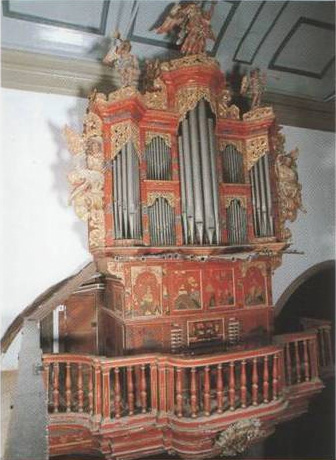
The organ case was built in 1684 by Mateo de Lago from Frechilla, using fir wood. Between 1687 and 1691, Juan García, an organist and organ builder also from Frechilla, created the instrument, of which the pipe work has remained unchanged to this day. The keyboard has the typical division of the Medio Registro with a range of 42 notes and a short octave.
In 1718, the Cascabeles (bells) with angel musicians were added. In 1730, a gallery was built on the northwest side of the church, where the organ was relocated by Antonio Rodríguez Carvajal from Sahagún. He expanded the treble range by three notes (up to c3), resulting in a total range of 45 notes, which is still found today. Additionally, he added three stops: Cimbala, corneta, and the vertical Trompeta Real, located at the back of the case. Furthermore, he enriched the organ with the stops Pájaros (Nightingale) and two sets of Tambores (Timpani, formed with two suspended tuned bass pipes each). Finally, he placed an angel with a trumpet on top of the case.
In 1788, the organ was overhauled and expanded by Antonio and Tomás Ruiz Martinez from Torquemada. The organ received new bellows, with four folding bellows feeding a large multiple magazine bellows. This system still works today. The organ builders also replaced the wind chests, stop knobs, actions, and keyboard, which is now faced with boxwood. Lastly, the instrument was modernized with three divided horizontal reed stops.
In 1832, 1886, and 1911, the organ was cleaned and the bellows repaired. By the late 1950s, it had become unplayable. In 1980, organ builder Daniel Birouste and organist Francis Chapelet, both from France, worked on a restoration. The bellows were repaired, the organ was cleaned, and a few missing pipes were replaced (treble range of Lleno and Címbala). The bass of the vertically standing Trompeta Real, which had since been lost, had to be rebuilt. Otherwise, the instrument still contains the original pipework from the years 1691, 1730, and 1788, along with the chests and mechanics from 1788, which respond very easily to this day. Although the organ has been playable again since 1983, it has essentially been preserved in its 1788 condition, as it has never been completely disassembled since then.
AI translated 04/2026