
 enEnglisch


Montblanc (Tarragona), Santa Maria
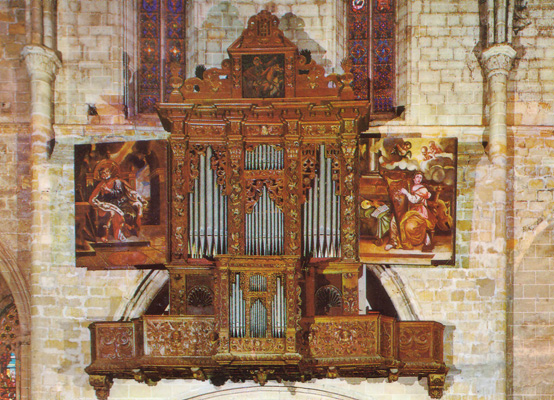
The Church of Santa Maria in Montblanc, dating back to the 14th century, houses one of the oldest and largely preserved organs in Catalonia. Typically for the region, only a few stops are divided. Instead, a positive organ was built as a second instrument. The main organ has 16 stops, the positive organ has 8, and the pedal has 5 stops.
The history of the instrument begins in 1607. In this year, the construction of an organ is mentioned for the first time. Further references can be found in 1636 and 1646, when repairs had to be carried out; an organist is first mentioned in 1642. The revolt of the Segadors (Reapers) against King Philip IV from 1640 to 1652 caused significant devastation in 1651, resulting in no church services being held in Santa Maria until 1685. In 1703, the city council decided to renew the church and organ to enhance the worship services. The text of the surviving document indicates that the organ was indeed built in 1607. However, it is unclear when the measures for renewal began. The case bears the date 1752, with a pencil entry by Josep Vicens from 1755 inside. This suggests a significant intervention. Nevertheless, the case does not appear to have been manufactured during that time for stylistic reasons. With great certainty, the horizontal reed stops were added only in the first half of the 18th century. The illustration clearly shows that they do not visually appear and could not have been part of the architectural concept from the beginning. In 1889, Juan Florenzano, an Italian organ builder, worked on the instrument. The short octave was corrected, meaning the missing notes were supplemented, and the treble range was extended from a2 to c3. Another repair took place in 1905. Since 1956, Pastor Josep Farré i Fortuny had been striving for a restoration, but it was not until 1977 that the work could be carried out and completed by Gabriel Blancafort and Georges Lhôte. Concurrently, Francesc Bonastre took on the music-historical research. Although the short octave was restored, the range was maintained at four octaves. One notable feature can be observed at the Rückpositiv. To save space, all the large pipes are made in a turned design. For the Flauta dolce, the pipes from the treble range onwards are then open and made of metal.
AI translated 04/2026