
 enEnglisch


Innsbruck-Wilten, Stiftskirche
Daniel Herz c1673-75, pedal before 1689.
State of preservation: Original except some single pipes, action parts and bellows. In1968 restored by Hans Pirchner, 2002/3 by Jürgen Ahrend.
The instrument is a rarity in being equipped with two octave couplers. As a pure Ripieno organ with diapason pipes only (except the Subbaß added in 1689) it shows the influence of the Italian ideal of organ sounds being achieved, however, by completely different technical means.
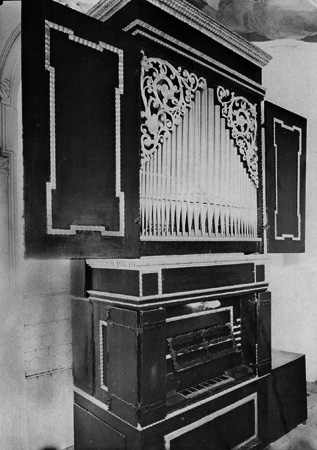
The basic idea of transmission (octave coupling) intends a reduction of pipes by a specific construction of the wind chest. Every key can open not one but three pallets and thus pipes in the distance of one and two octaves. For example with the Principal rank it means that with octave couplers active the key for c1 sounds the c1 as well as c2 and c3 of the same rank. Thus every rank gives three stops. At a price with pipes for two additional octaves above the manual compass three ranks seem to give nine stops with remarkably reduced space and material. This so seemingly fascinating technical construction comes with a severe musical disadvantage though. If eg (8’+4’ pulled) a chord of c1-e1-g1-c2 is to be played, the highest note is not sounding properly since its pipe serves already as the upper octave of the lowest note. The results are audible sound gaps which, depending on the structure of a composition, can severely diminish its impression. Therefore during the 16th to 18th century octave couplers were considered an emergency measure for example for single pedal stops or within limited space. As a basic principle of a complete organ the octave couplers of Wilten organ are unique in this era.
In the late 19th and early 20th century octave couplers became very popular to impress customers with ever growing numbers of organ stops.
Music Sample
Johann Kaspar Kerll (1627-1693): Capriccio sopra il Cuco, played by Kurt Estermann